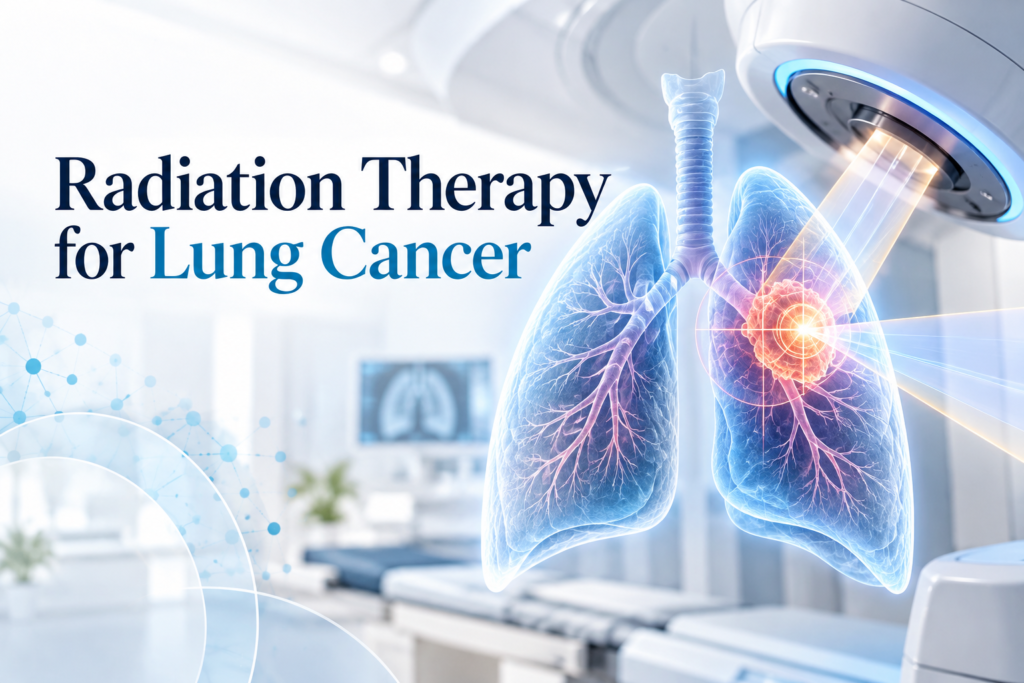
Lung cancer treatment has advanced significantly over the years, with patients now having access to more precise and personalised treatment approaches. Depending on the type and stage of lung cancer, treatment may involve surgery, chemotherapy, immunotherapy, targeted therapy, radiation therapy, or a combination of these treatments.
Among these options, radiation therapy for lung cancer plays an important role at different stages of the disease. It may be recommended as the primary treatment for patients who cannot undergo surgery, combined with chemotherapy for locally advanced cancers, used after or before surgery in selected cases, or given to control symptoms when cancer has spread.
Modern radiation technologies allow radiation oncologists to deliver carefully planned doses to cancerous tissue while limiting radiation exposure to surrounding healthy structures.
For patients looking for the best radiation oncologist in Faridabad, consultation with an experienced specialist such as Dr. Vikash Kumar, Director & Head – Radiation Oncology, Metro Cancer Institute, can help determine whether radiation therapy is suitable based on the cancer type, stage, location, overall health, and individual treatment goals.
What Is Radiation Therapy for Lung Cancer?
Radiation therapy is a cancer treatment that uses high-energy radiation, such as X-rays, to destroy cancer cells or prevent them from continuing to grow.
During external beam radiation therapy, radiation is generated by a specialised machine outside the body and precisely directed toward the tumour.
According to the National Cancer Institute, external radiation therapy is used in the treatment of non-small cell lung cancer as well as small cell lung cancer, depending on the patient’s clinical situation.
Radiation therapy may be given with different goals:
- To eliminate or control a localised lung tumour
- To shrink a tumour before another treatment
- To destroy remaining cancer cells after treatment
- To treat lymph nodes affected by cancer
- To control cancer that cannot be surgically removed
- To treat cancer that has spread to areas such as the brain or bones
- To relieve symptoms associated with advanced lung cancer
The treatment plan is individualised because lung cancer does not behave the same way in every patient.
When Is Radiation Therapy Recommended for Lung Cancer?
Whether radiation therapy is recommended depends primarily on:
- Type of lung cancer
- Stage of disease
- Size of the tumour
- Tumour location
- Lymph node involvement
- Whether cancer has spread to another organ
- Patient’s lung function
- Overall health and fitness
- Previous treatments
- Possibility of surgery
- Molecular characteristics of the cancer
A multidisciplinary cancer team may evaluate these factors before recommending the most appropriate treatment strategy.
The American Cancer Society notes that radiation therapy may be used as the main treatment, before or after surgery in selected situations, for cancer that has spread elsewhere in the body, or to provide symptom relief.
Let’s understand these situations in more detail.
1. Radiation Therapy for Early-Stage Lung Cancer
Surgery is commonly considered for many patients with early-stage non-small cell lung cancer (NSCLC) who are medically fit for an operation.
However, some patients may not be suitable candidates for surgery because of:
- Reduced lung function
- Advanced age with significant medical conditions
- Serious cardiovascular disease
- Other health problems that increase surgical risk
- Tumour location
- Patient preference after appropriate medical counselling
In selected early-stage NSCLC patients who cannot undergo surgery, a highly focused form of radiation therapy called Stereotactic Body Radiation Therapy (SBRT) or Stereotactic Ablative Radiotherapy (SABR) may be considered.
The American Cancer Society describes SBRT as an approach frequently used for early-stage lung cancers when surgery is not an appropriate option because of health considerations or when a patient does not wish to undergo surgery.
ASTRO also has clinical guidance addressing SBRT for early-stage non-small cell lung cancer, including its use in medically inoperable patients and other selected clinical situations.
What Is SBRT for Lung Cancer?
SBRT delivers highly focused doses of radiation to a relatively small tumour target using advanced imaging, immobilisation and treatment planning.
Compared with conventional radiation therapy, SBRT generally delivers higher radiation doses per treatment over fewer treatment sessions.
The exact number of sessions depends on several factors, including:
- Tumour size
- Tumour location
- Distance from important organs
- Lung function
- Treatment planning parameters
SBRT requires a high level of precision because structures such as the heart, oesophagus, spinal cord and healthy lung tissue may be located close to the tumour.
2. Radiation Therapy for Locally Advanced Lung Cancer
Radiation treatment is particularly important in locally advanced non-small cell lung cancer, including many stage III cases.
In these patients, the cancer may have spread into nearby lymph nodes or structures within the chest but may not be appropriate for surgical removal.
For suitable patients with unresectable stage III NSCLC, radiation therapy may be combined with chemotherapy.
The National Cancer Institute notes that patients with unresectable or certain node-positive locally advanced NSCLC may receive radiation in combination with chemotherapy.
What Is Concurrent Chemoradiation?
When chemotherapy and radiation therapy are administered during the same treatment period, the approach is known as concurrent chemoradiation.
Chemotherapy may make cancer cells more sensitive to radiation, while radiation works directly on the tumour and involved lymph nodes.
However, concurrent treatment may also produce more side effects than either treatment alone, which means the patient’s overall health, nutrition, lung function and treatment tolerance must be considered carefully.
Some patients may receive chemotherapy and radiation sequentially rather than simultaneously.
The exact treatment approach should therefore be determined individually by the oncology team.
3. Radiation Therapy When Surgery Is Not Possible
Not every lung tumour can be surgically removed.
Surgery may not be appropriate because:
- The tumour involves important structures
- The cancer has extensive regional lymph-node involvement
- Lung function is inadequate for surgery
- The patient has serious medical conditions
- Surgical risk is considered too high
In such situations, radiation therapy may become an important component of definitive treatment.
For some patients, radiation may be given alone, while others may receive radiation with chemotherapy, immunotherapy or other systemic treatments based on the stage and biological characteristics of their cancer.
The NCI lists external radiation therapy as a treatment option for certain patients with stage IIIB or IIIC NSCLC, including those who cannot receive chemotherapy.
4. Radiation Therapy Before Lung Cancer Surgery
Radiation therapy may occasionally be given before surgery, usually as part of a combined treatment strategy.
This is known as neoadjuvant radiation therapy.
The purpose may be to:
- Reduce tumour size
- Improve local tumour control
- Treat nearby lymph nodes
- Make selected tumours easier to remove surgically
Radiation before surgery is not required for every lung cancer patient.
Treatment decisions depend on the exact tumour location, lymph-node involvement, operability and findings from investigations such as CT, PET-CT, bronchoscopy and tissue biopsy.
The American Cancer Society notes that radiation may sometimes be given before surgery, often together with chemotherapy, to shrink a lung tumour and make surgery easier.
5. Radiation Therapy After Lung Cancer Surgery
Radiation treatment may sometimes be considered after surgery, known as postoperative or adjuvant radiation therapy.
The goal is to treat microscopic cancer cells that may remain in the region despite surgery.
However, postoperative radiation is not routinely required for every patient who undergoes lung cancer surgery.
Factors that may influence this decision include:
- Surgical margin status
- Lymph-node involvement
- Stage of cancer
- Location of involved nodes
- Pathology findings
- Overall recurrence risk
The NCI notes that postoperative radiation remains a selective treatment consideration in NSCLC rather than a universal recommendation, with its role depending on the specific clinical situation.
Therefore, the decision should be made after reviewing the complete surgical and pathological findings.
6. Radiation Therapy for Small Cell Lung Cancer
Lung cancer is broadly divided into:
Non-Small Cell Lung Cancer (NSCLC)
This represents the majority of lung cancer cases and includes subtypes such as:
- Adenocarcinoma
- Squamous cell carcinoma
- Large cell carcinoma
Small Cell Lung Cancer (SCLC)
Small cell lung cancer generally behaves more aggressively and tends to spread earlier.
Radiation therapy has an important role in the management of limited-stage small cell lung cancer, where it may be given with chemotherapy.
The National Cancer Institute identifies chemotherapy combined with thoracic radiation as an established treatment approach for limited-stage SCLC.
Depending on the stage and response to treatment, radiation may also be considered in other situations.
The American Cancer Society notes that chest radiation can be used alongside chemotherapy in limited-stage disease and may also have a role after chemotherapy in selected patients.
7. Radiation Therapy When Lung Cancer Spreads to the Brain
The brain is one of the possible sites to which lung cancer may spread.
Treatment for brain metastases from lung cancer depends on:
- Number of brain lesions
- Size of lesions
- Location
- Neurological symptoms
- Overall cancer burden
- Molecular profile
- General condition of the patient
Radiation treatment options can include highly focused stereotactic radiation approaches for selected patients or other brain-directed treatment strategies where appropriate.
The NCI describes stereotactic radiosurgery as a treatment capable of delivering a highly focused dose of radiation to certain lung cancer metastases in the brain.
The best approach should be determined after reviewing brain imaging and the patient’s overall cancer status.
8. Radiation Therapy for Lung Cancer That Has Spread to Bones
Lung cancer may sometimes spread to bones, causing:
- Persistent pain
- Difficulty walking
- Reduced mobility
- Risk of fracture
- Pressure on nearby nerves
- Spinal complications in certain cases
Radiation therapy can be highly valuable in controlling symptoms arising from bone metastases.
In these cases, radiation therapy is generally aimed at controlling the affected tumour area, reducing pain and improving quality of life rather than treating the entire body’s cancer burden.
9. Palliative Radiation Therapy for Advanced Lung Cancer
Radiation therapy is not used only with curative intent.
In advanced lung cancer, palliative radiation therapy may help relieve symptoms caused by the tumour.
Radiation may be considered for symptoms such as:
- Persistent chest pain
- Bleeding or coughing up blood
- Difficulty swallowing
- Airway compression
- Persistent cough
- Shortness of breath
- Pain caused by bone metastases
- Symptoms caused by brain metastases
The NCI identifies several symptoms from locally advanced NSCLC that can potentially be palliated using radiation, including pain, airway or oesophageal compression and haemoptysis.
Palliative treatment schedules may be shorter than those used for definitive cancer treatment.
Modern Radiation Therapy Techniques for Lung Cancer
Radiation oncology has become increasingly precise.
Instead of simply directing broad radiation fields toward an anatomical region, modern radiation planning can use sophisticated imaging and computer-guided treatment delivery to conform radiation more closely to the tumour.
Depending on the patient’s clinical requirements and the technology available, treatment may involve techniques such as:
3D Conformal Radiation Therapy
3D treatment planning uses imaging to identify the tumour and surrounding organs and shapes radiation beams according to the target.
Intensity-Modulated Radiation Therapy (IMRT)
IMRT enables different radiation intensities to be delivered across treatment beams, helping radiation oncologists shape the dose around complex tumour areas.
Image-Guided Radiation Therapy (IGRT)
Imaging performed during the treatment process helps verify patient and tumour positioning.
This is particularly important in lung cancer because tumours can move as the patient breathes.
Stereotactic Body Radiation Therapy (SBRT/SABR)
SBRT delivers highly focused radiation doses to selected small tumours and is especially important in appropriately selected early-stage lung cancer patients.
Stereotactic Radiosurgery (SRS)
Despite the word “surgery,” SRS is a radiation technique rather than a surgical operation.
It may be considered for selected brain metastases.
Modern radiation techniques aim to improve targeting while reducing unnecessary radiation exposure to surrounding healthy tissues.
How Is Radiation Therapy Planned for Lung Cancer?
Radiation treatment begins well before the first treatment session.
1. Radiation Oncology Consultation
The radiation oncologist reviews:
- Biopsy report
- CT scan
- PET-CT findings
- MRI when required
- Previous treatment history
- Lung function
- Medical history
- Cancer stage
2. CT Simulation
A planning CT scan is performed with the patient positioned in the treatment position.
Immobilisation devices may be used to help maintain consistent positioning.
3. Tumour and Organ Mapping
The radiation oncologist identifies:
- Visible tumour
- Areas requiring treatment
- Healthy lung
- Heart
- Oesophagus
- Spinal cord
- Other nearby critical structures
4. Treatment Planning
Advanced computer software calculates radiation beam arrangements and dose distribution.
The aim is to provide adequate radiation coverage of the tumour while respecting safe dose limits for normal organs.
5. Treatment Delivery
After the radiation plan has undergone the required checks, treatment begins.
The patient usually does not feel the radiation being delivered.
Does Radiation Therapy Hurt?
Radiation therapy itself is generally painless.
Patients usually lie on the treatment table while the radiation machine moves around them or delivers radiation from predetermined angles.
The treatment team monitors the patient throughout the procedure.
Although radiation delivery itself does not usually cause pain, side effects may gradually develop during a treatment course.
Possible Side Effects of Lung Cancer Radiation Therapy
Side effects vary considerably between patients.
They depend on:
- Total radiation dose
- Number of treatment sessions
- Area being treated
- Amount of healthy lung receiving radiation
- Whether chemotherapy is given simultaneously
- Patient’s overall health
Possible side effects can include:
Fatigue
Tiredness may gradually increase during radiation therapy.
Skin Changes
Patients may experience mild redness, dryness or sensitivity in the treated region.
Difficulty Swallowing
Radiation delivered near the oesophagus can sometimes cause irritation and discomfort while swallowing.
Cough or Shortness of Breath
Some patients may experience temporary respiratory symptoms.
Radiation Pneumonitis
Inflammation of lung tissue can occasionally develop after radiation treatment.
Symptoms can include:
- Cough
- Shortness of breath
- Low-grade fever
- Chest discomfort
Patients experiencing new or worsening respiratory symptoms after treatment should contact their oncology team promptly.
Not every patient develops these effects, and the severity varies.
How Long Does Radiation Therapy for Lung Cancer Take?
There is no single treatment duration for every patient.
The treatment course depends on:
- Cancer stage
- Treatment intent
- Radiation technique
- Tumour location
- Dose required
- Whether chemotherapy is being administered
- Patient’s overall condition
Some conventional treatment schedules may extend over several weeks, whereas SBRT may require substantially fewer treatment sessions.
Palliative radiation schedules can also be relatively short.
Your radiation oncologist determines the treatment duration according to your personalised treatment plan.
Benefits of Precision Radiation Therapy for Lung Cancer
Modern radiation therapy can provide several potential advantages for appropriately selected patients:
- Precise tumour targeting
- Better protection of surrounding healthy tissues
- Non-surgical treatment option in selected patients
- Treatment of tumours in difficult anatomical locations
- Integration with chemotherapy and other cancer treatments
- Treatment of certain metastatic lesions
- Symptom relief in advanced disease
- Individualised radiation dose planning
The objective is not simply to deliver radiation but to deliver the appropriate radiation dose to the appropriate target while minimising exposure to surrounding organs.
Consult Dr. Vikash Kumar – Radiation Oncologist in Faridabad
Selecting the appropriate radiation technique requires detailed assessment by an experienced radiation oncology team.
Dr. Vikash Kumar, Director & Head – Radiation Oncology at Metro Cancer Institute, provides consultation and radiation oncology care for patients with lung cancer and other malignancies.
With extensive experience in radiation oncology, Dr. Vikash Kumar evaluates factors such as cancer stage, tumour location, previous treatment, imaging findings, overall health and treatment goals before recommending an individualised radiation plan.
For patients searching online for the best radiation oncologist in Faridabad, it is important to look beyond the phrase “best” and choose a radiation oncologist based on relevant experience, available technology, multidisciplinary cancer care, personalised treatment planning and the patient’s individual clinical requirements.
A specialist consultation with Dr. Vikash Kumar, Radiation Oncologist in Faridabad, can help patients and families understand whether radiation therapy should form part of their lung cancer treatment plan.
Frequently Asked Questions About Radiation Therapy for Lung Cancer
1. Is radiation therapy effective for lung cancer?
Radiation therapy can play an important role in lung cancer treatment. Its effectiveness depends on the type and stage of cancer, tumour size and location, overall health and whether it is combined with other treatments.
2. Can radiation therapy cure lung cancer?
Radiation therapy may be used with curative intent in selected patients, including some people with localised disease who cannot undergo surgery and certain patients receiving combined treatment for locally advanced cancer. In advanced disease, radiation may instead be used to control specific cancer sites or relieve symptoms.
3. Is radiation better than surgery for lung cancer?
Neither treatment is universally “better.” Surgery is appropriate for certain operable early-stage cancers, while radiation may be preferred when surgery is not medically appropriate or as part of treatment for more advanced disease. Treatment should be individualised.
4. What is SBRT for lung cancer?
Stereotactic Body Radiation Therapy, also called SABR, is an advanced radiation technique that delivers highly focused radiation to a defined tumour target over a relatively small number of treatment sessions.
5. How many radiation sessions are needed for lung cancer?
The number of sessions varies according to the type, stage and location of the cancer and the radiation technique being used. Treatment may range from a short course to several weeks.
6. Will radiation therapy damage healthy lung tissue?
Radiation treatment inevitably exposes some surrounding tissue to radiation, but modern planning techniques aim to minimise unnecessary exposure while providing the required dose to the tumour.
7. Can chemotherapy and radiation be given together?
Yes. Concurrent chemoradiation is commonly considered in certain locally advanced lung cancers when the patient is medically suitable.
8. Can lung cancer that has spread to the brain be treated with radiation?
Yes. Radiation therapy is one treatment option for brain metastases from lung cancer. Highly focused stereotactic radiation may be suitable for selected patients.
9. Can radiation therapy reduce lung cancer pain?
Yes. Palliative radiation therapy can help relieve symptoms caused by advanced cancer, including pain caused by tumour involvement or bone metastases.
10. Who should I consult for lung cancer radiation therapy in Faridabad?
Patients considering radiation therapy should consult a qualified radiation oncologist. Dr. Vikash Kumar, Director & Head – Radiation Oncology, Metro Cancer Institute, provides specialised radiation oncology consultation in Faridabad and can assess whether radiation therapy is appropriate for an individual patient’s condition.
Conclusion
Radiation therapy for lung cancer is an important component of modern cancer care and can be used across different stages of the disease.
For some patients with early-stage lung cancer who cannot undergo surgery, advanced radiation techniques such as SBRT may provide a non-surgical treatment approach. For locally advanced disease, radiation may be combined with chemotherapy. Radiation can also be used to treat selected metastatic sites and provide relief from symptoms such as pain, bleeding, airway obstruction and other problems caused by advanced cancer.
Most importantly, radiation therapy should never follow a one-size-fits-all approach.
The decision to use radiation depends on the type of lung cancer, stage, tumour location, imaging findings, lung function, overall health and previous treatments.
Patients looking for the best radiation oncologist in Faridabad can consult Dr. Vikash Kumar, Director & Head – Radiation Oncology, Metro Cancer Institute, for a comprehensive evaluation and personalised radiation treatment plan.
Early consultation with an oncology specialist can help patients understand their treatment options and make informed decisions about the next step in their cancer care.
Disclaimer: This information is intended for general educational purposes and should not replace personalised medical consultation. Lung cancer treatment varies from patient to patient. Treatment decisions should be made after evaluation by a qualified oncology team.