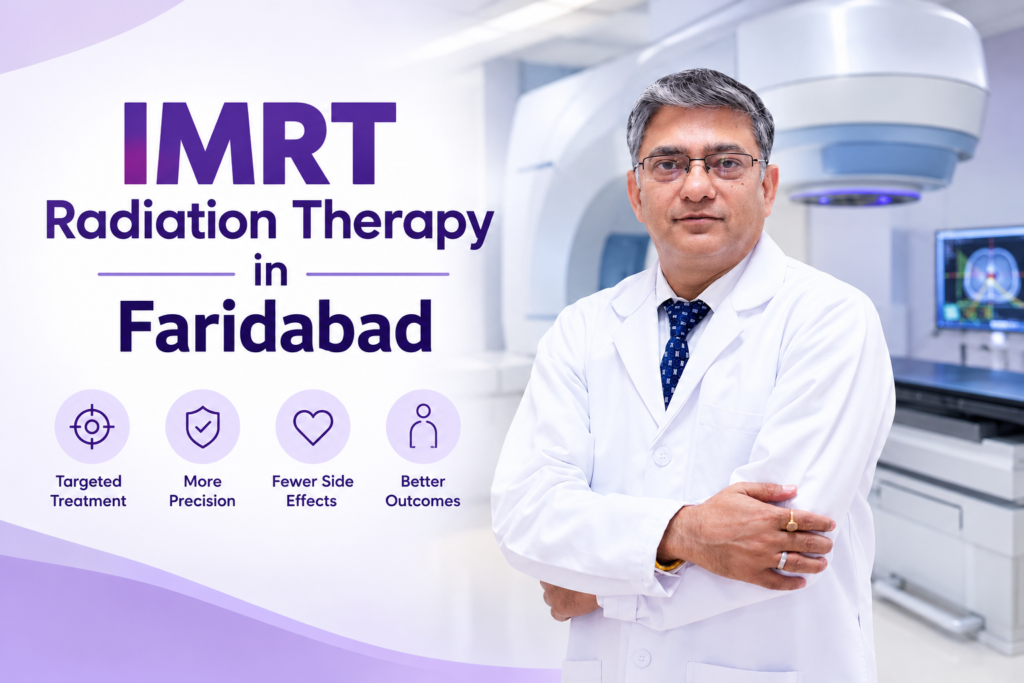
A cancer diagnosis can bring many questions, especially when patients and families begin exploring treatment options. One of the most common concerns is whether radiation therapy can effectively target cancer while protecting surrounding healthy tissues.
Advances in radiation oncology have made cancer treatment increasingly precise. One such advancement is Intensity-Modulated Radiation Therapy (IMRT), a sophisticated radiation treatment technique designed to deliver carefully controlled radiation doses to cancerous tissues while limiting unnecessary exposure to nearby healthy organs.
For patients exploring IMRT Radiation Therapy in Faridabad, understanding how this technology works, when it is recommended, its potential benefits, and its possible side effects can help them make informed treatment decisions.
Dr. Vikash Kumar, a best Radiation Oncologist in Faridabad with extensive experience in radiation oncology, provides guidance on modern cancer treatment approaches, including precision radiation techniques. For individuals searching for the best radiation oncologist in Faridabad, his expertise is an important consideration when seeking personalised cancer treatment guidance.
This comprehensive guide explains everything patients should know about IMRT radiation therapy, from treatment planning to recovery and follow-up care.
What Is IMRT Radiation Therapy?
Intensity-Modulated Radiation Therapy (IMRT) is an advanced form of external beam radiation therapy that uses computer-controlled technology to deliver radiation doses precisely to a cancerous tumour or a selected treatment area.
Unlike older radiation techniques that use relatively uniform radiation beams, IMRT adjusts the intensity of multiple smaller beams. This enables radiation oncologists to shape the radiation dose around complex tumours while reducing exposure to surrounding normal tissues.
IMRT is particularly valuable when a tumour is located close to sensitive structures such as the spinal cord, salivary glands, brain, bladder, rectum, or other important organs.
Its fundamental objective is to achieve an appropriate radiation dose distribution for cancer treatment while respecting safe dose limits for surrounding tissues.
According to the National Cancer Institute, IMRT uses beams of different intensities directed toward the treatment area from several angles to reduce radiation damage to nearby healthy tissues.
How Does IMRT Radiation Therapy Work?
IMRT combines sophisticated imaging, computerised treatment planning, and modern radiation-delivery equipment.
Before beginning treatment, the radiation oncology team identifies the exact area requiring radiation. Imaging studies, including CT scans and sometimes MRI or PET scans, help doctors understand the tumour’s location, shape, size, and relationship with surrounding organs.
A specialised treatment-planning system then calculates the radiation dose distribution.
Rather than delivering the same radiation intensity throughout each beam, IMRT allows different portions of the beam to deliver different amounts of radiation.
This flexibility helps the treatment team create a highly conformal radiation plan.
Important components of IMRT technology
1. Advanced Imaging
CT-based planning, supplemented by MRI or PET imaging when appropriate, helps identify the treatment target and nearby organs.
2. Computerised Treatment Planning
Specialised software calculates how radiation beams should be arranged to deliver the prescribed dose while respecting normal-tissue constraints.
3. Linear Accelerator (LINAC)
A linear accelerator generates the high-energy radiation used for treatment.
4. Multileaf Collimator (MLC)
A multileaf collimator contains numerous movable metal leaves that shape the radiation beams and help modulate their intensity.
5. Quality Assurance
Before treatment begins, medical physicists and the radiation oncology team verify the treatment plan and perform necessary safety checks.
Together, these components make IMRT an important option in modern precision radiation oncology.
Intensity-Modulated Radiation Therapy
Which Types of Cancer Can Be Treated with IMRT?
IMRT can be used for several types of cancer. However, its suitability depends on the location, stage, size, and biological characteristics of the tumour, along with the patient’s overall health and treatment goals.
1. Head and Neck Cancer
Head and neck cancers may involve the tongue, throat, tonsils, voice box, oral cavity, or nearby structures.
Radiation treatment in these areas requires careful planning because several sensitive organs are located close together.
IMRT helps limit radiation exposure to structures such as the salivary glands, spinal cord, and swallowing muscles when clinically feasible.
Reducing radiation doses to selected healthy structures may help lower the risk of certain complications, including dry mouth and swallowing difficulties.
Patients diagnosed with head and neck cancer may benefit from discussing IMRT and other treatment approaches with an experienced radiation oncologist.
2. Prostate Cancer
Prostate cancer is another important application of IMRT.
The prostate lies close to the bladder and rectum, making accurate radiation delivery particularly important.
IMRT can shape the radiation dose around the prostate or prostate bed while helping reduce unnecessary exposure to surrounding organs.
It may be used as a primary treatment, after surgery in selected patients, or as part of a broader treatment strategy.
Treatment decisions depend on factors such as PSA level, tumour grade, stage, previous treatments, and individual risk assessment.
3. Breast Cancer
Radiation therapy is frequently recommended after breast-conserving surgery and in selected patients after mastectomy.
In certain situations, IMRT may help improve dose uniformity within the breast or chest wall and reduce radiation exposure to nearby normal tissues.
This can be especially relevant when treating complex breast or regional lymph-node areas.
However, IMRT is not necessary for every breast cancer patient. Other techniques, including three-dimensional conformal radiation therapy and deep inspiration breath hold, may also be appropriate depending on the treatment plan.
4. Lung Cancer
Lung tumours may be located close to sensitive structures such as the heart, oesophagus, spinal cord, and healthy lung tissue.
IMRT can help optimise the radiation dose delivered to the treatment target while considering dose limits for these surrounding organs.
It may be used in selected patients receiving definitive radiation therapy, combined chemoradiation, or other individualised treatment approaches.
For some early-stage lung cancers, stereotactic body radiation therapy (SBRT) may be considered instead.
The radiation oncologist evaluates which approach is most appropriate for the patient’s disease and clinical condition.
5. Brain Tumours
Certain brain tumours require highly precise radiation treatment because important functional areas of the brain may be located close to the treatment target.
IMRT can be used for selected primary brain tumours and other intracranial conditions when fractionated radiation therapy is indicated.
The treatment team carefully assesses the radiation dose to normal brain tissue and critical structures.
For smaller or well-defined lesions, stereotactic radiosurgery or stereotactic radiotherapy may be more suitable.
6. Cervical and Other Pelvic Cancers
IMRT may also be used for cervical cancer and selected other pelvic malignancies.
The technique can help reduce radiation exposure to portions of the bowel, bladder, rectum, and other pelvic tissues compared with less conformal plans.
For many patients with locally advanced cervical cancer, radiation treatment may include external beam radiation, concurrent chemotherapy, and brachytherapy.
IMRT does not replace brachytherapy when brachytherapy is an essential part of the recommended treatment. Each component has a different role in achieving effective cancer control.
Major Benefits of IMRT Radiation Therapy
Modern cancer treatment aims not only to control the disease but also to preserve normal organ function wherever possible.
The potential advantages of IMRT include:
1. More Precise Radiation Delivery
IMRT allows radiation oncologists to create dose distributions that closely conform to irregularly shaped treatment targets.
This is particularly important for tumours located near sensitive organs.
2. Better Protection of Surrounding Healthy Tissues
One of the most important advantages of IMRT is its ability to reduce radiation exposure to selected normal tissues.
This may lower the likelihood or severity of certain treatment-related side effects compared with less conformal radiation techniques.
However, side effects cannot be eliminated completely.
3. Individualised Treatment Planning
Every patient’s cancer is different.
IMRT treatment planning considers the tumour’s characteristics, nearby organs, previous treatments, and the intended treatment outcome.
The resulting radiation plan is tailored to the individual clinical situation.
4. Suitable for Complex Tumour Shapes
Some tumours have irregular shapes or extend around sensitive anatomical structures.
IMRT provides flexibility in shaping the radiation dose around such targets, making it useful for selected complex treatment situations.
5. Potential for Improved Treatment Tolerance
By reducing radiation exposure to particular normal tissues, IMRT may help reduce certain complications and support treatment tolerance.
The extent of benefit varies by cancer site, prescribed dose, and treatment plan.
6. Integration with Other Cancer Treatments
IMRT can be incorporated into broader treatment strategies involving surgery, chemotherapy, targeted therapy, or other medical treatments when clinically appropriate.
It is important to understand that IMRT is not automatically superior for every patient. An experienced radiation oncologist determines whether its planning advantages provide meaningful clinical benefits in a particular case.
Step-by-Step IMRT Radiation Therapy Procedure
Patients considering IMRT Treatment in Faridabad often want to know what happens before, during, and after the procedure.
Although treatment plans vary, the process generally involves the following stages.
Step 1: Initial Oncology Consultation
The treatment process begins with a detailed clinical evaluation.
The radiation oncologist reviews the patient’s diagnosis, biopsy results, imaging investigations, previous treatments, medical history, and overall condition.
The doctor also discusses treatment goals, expected benefits, potential risks, and available alternatives.
Step 2: CT Simulation and Positioning
Before treatment begins, a planning CT scan is performed.
The patient is positioned carefully on a specialised treatment table.
Depending on the treatment area, positioning aids such as thermoplastic masks, vacuum cushions, or other immobilisation devices may be used to help maintain a consistent position during subsequent sessions.
Small reference marks may also be placed on the skin.
Step 3: Radiation Treatment Planning
The radiation oncologist outlines the treatment target and nearby organs that need protection.
Medical physicists and dosimetrists use specialised software to calculate the radiation dose distribution.
Several plans may be evaluated to achieve a suitable balance between tumour coverage and normal-tissue protection.
Step 4: Plan Verification and Quality Assurance
Before beginning treatment, the plan undergoes necessary checks.
The radiation oncology team verifies the calculations, machine delivery parameters, and planned radiation distribution.
This step is essential to safe and accurate radiation delivery.
Step 5: Daily IMRT Treatment Sessions
During each treatment session, the patient lies on the treatment table in the planned position.
Radiation therapists carefully align the patient. Imaging may be performed to verify positioning before treatment.
The linear accelerator delivers the prescribed radiation while the patient remains still.
The radiation itself is painless and cannot be felt.
The treatment team monitors the patient from outside the room and can communicate throughout the procedure.
Step 6: Follow-Up and Treatment Monitoring
Throughout the course of radiation therapy, the oncology team monitors treatment tolerance, side effects, nutrition, and general well-being.
After completion, scheduled follow-up visits help assess recovery, treatment response, and any delayed side effects.
How Many IMRT Sessions Are Required?
The number of IMRT sessions depends on several factors, including:
- Type and stage of cancer
- Size and location of the tumour
- Treatment intent
- Radiation dose prescribed
- Previous cancer treatments
- Overall health and organ tolerance
Some patients may require only a relatively short treatment course, while others may need several weeks of daily sessions.
Many conventional radiation schedules involve treatment five days a week, usually Monday through Friday.
However, shorter hypofractionated schedules are appropriate for certain cancers.
There is no fixed number of IMRT sessions suitable for everyone. A radiation oncologist prepares the schedule after reviewing the individual clinical condition.
Is IMRT Radiation Therapy Painful?
IMRT itself is generally painless.
Patients do not feel radiation entering the body.
During the procedure, the main requirement is to remain still in the treatment position while the machine delivers radiation.
Some patients may experience discomfort from lying in one position or wearing an immobilisation device, particularly if they already have pain or difficulty moving.
The radiation therapy team can help address positioning difficulties and improve comfort wherever possible.
Treatment-related side effects may develop gradually over subsequent sessions, but these are different from pain caused by radiation delivery itself.
Another common concern is whether patients become radioactive after treatment.
External beam radiation therapy, including IMRT, does not make the patient radioactive. Patients can generally interact safely with family members after treatment.
Possible Side Effects of IMRT Radiation Therapy
Although IMRT is designed to reduce unnecessary radiation exposure, it may still cause side effects.
The nature and severity of these effects depend on the treated body part, prescribed radiation dose, treatment duration, and individual patient factors.
Common possible effects include fatigue and skin irritation in the treatment area.
Head and Neck Radiation
Patients may experience mouth dryness, altered taste, mouth ulcers, swallowing difficulties, or throat discomfort.
Some symptoms improve after treatment, while others may persist longer.
Chest Radiation
Potential side effects include swallowing discomfort, cough, or inflammation affecting the lungs.
New or worsening breathing problems require prompt medical evaluation.
Abdominal and Pelvic Radiation
Some patients may experience nausea, bowel changes, diarrhoea, bladder irritation, or increased urinary frequency.
Late Side Effects
Certain complications may develop months or years after radiation therapy, including changes in the function of tissues or organs exposed to radiation.
The risk depends on the treated region and the radiation doses received.
Regular follow-up is important for identifying and managing delayed effects.
IMRT may reduce certain risks compared with other radiation approaches, but it cannot guarantee an absence of side effects.
IMRT vs Conventional Radiation Therapy: What Is the Difference?
Patients often ask whether advanced radiation therapy is better than conventional treatment.
The answer depends on the disease, treatment location, and specific radiation plan.
| Feature | Conventional 3D-CRT | IMRT |
|---|---|---|
| Radiation delivery | Shaped beams, generally with uniform intensity per beam | Modulated intensity across multiple smaller beam segments |
| Dose shaping | Conforms to tumour geometry | Can conform more closely to complex targets |
| Normal tissue protection | Depends on beam arrangement | Can reduce dose to selected normal tissues |
| Planning complexity | Generally lower | Generally higher |
| Treatment suitability | Appropriate for many cancers | Particularly useful in selected complex cases |
IMRT may offer meaningful advantages when a tumour is located near sensitive tissues. However, a simpler technique may be equally appropriate in some clinical situations.
The goal is to choose the safest and most effective radiation plan for the individual patient, rather than selecting a technique solely because it is newer.
IMRT vs IGRT vs VMAT: Understanding the Difference
Patients frequently encounter several technical terms while researching advanced radiation therapy.
IMRT (Intensity-Modulated Radiation Therapy) refers to a technique that adjusts radiation beam intensity to produce a precisely shaped dose distribution.
IGRT (Image-Guided Radiation Therapy) refers to the use of imaging during the treatment process to improve positioning accuracy and account for anatomical changes.
VMAT (Volumetric Modulated Arc Therapy) is a form of IMRT in which radiation is delivered while the treatment machine rotates around the patient, adjusting beam characteristics during the movement.
These approaches are related rather than necessarily competing.
For example, a patient may receive VMAT treatment combined with image guidance.
The radiation oncology team determines which technique or combination is clinically appropriate.
Intensity-Modulated Radiation Therapy
Who Is an Ideal Candidate for IMRT?
IMRT may be considered for patients who:
- Have tumours located close to important organs or sensitive tissues.
- Require radiation for certain head and neck, prostate, brain, breast, lung, or pelvic cancers.
- Have complex treatment targets that benefit from conformal dose shaping.
- Need radiation as part of multidisciplinary cancer management.
- May benefit from a treatment plan designed to limit the dose to selected normal tissues.
However, IMRT is not recommended solely on the basis of a cancer diagnosis.
The radiation oncologist evaluates the clinical benefits, potential risks, treatment goals, and available alternatives before recommending a specific technique.
Why Choose Dr. Vikash Kumar for Radiation Oncology Consultation in Faridabad?
When considering advanced cancer treatment, choosing a radiation oncologist with relevant clinical experience is an important part of the decision-making process.
Patients searching online for the best radiation oncologist in Faridabad often look for a specialist who understands modern radiation techniques and can explain complex treatment decisions in a clear, patient-friendly manner.
Dr. Vikash Kumar, Clinical Oncologist, has more than two decades of professional experience and an academic background associated with the Institute of Medical Sciences, Banaras Hindu University (IMS-BHU).
His clinical focus includes modern radiation oncology and precision treatment approaches, including IMRT, IGRT, VMAT, and other advanced radiation techniques.
His approach emphasises individualised treatment planning, understanding each patient’s cancer diagnosis, and balancing effective treatment with protection of surrounding healthy tissues.
Patients seeking guidance on IMRT radiation therapy in Faridabad can consult Dr. Vikash Kumar to discuss whether this technique is suitable for their condition and where appropriate treatment can be delivered.
The most appropriate treatment recommendation depends on a detailed clinical assessment and the availability of the required treatment technology.
IMRT Radiation Therapy Cost in Faridabad
The cost of IMRT radiation therapy in Faridabad varies according to the complexity of the treatment and the healthcare facility.
Several factors may influence the overall expense.
These include the number of prescribed radiation sessions, treatment planning requirements, imaging investigations, specialised immobilisation devices, the hospital’s equipment and billing arrangements, and whether additional treatments are required.
Patients should request a personalised cost estimate before beginning treatment.
It is also advisable to discuss insurance coverage, cashless facilities, and applicable financial assistance programmes with the treating hospital.
Choosing a treatment facility should involve more than cost alone. Clinical expertise, appropriate equipment, quality assurance procedures, and access to supportive care are important considerations.
How to Prepare for IMRT Radiation Therapy
Preparing properly for treatment can make the experience easier and help patients feel more confident.
Before starting radiation therapy, patients should share complete medical records, previous cancer-treatment information, and details of all medications with their oncology team.
Maintaining adequate nutrition and hydration is important, particularly when radiation treatment may affect eating or swallowing.
Patients should avoid applying creams or other products to the treatment area without medical guidance.
Comfortable clothing may make daily appointments easier.
Patients receiving head and neck radiation may also require dental assessment, nutritional counselling, or swallowing-related support depending on their treatment plan.
Smoking cessation is strongly recommended, and alcohol intake should be discussed with the treating clinician.
Most importantly, patients should report new symptoms rather than waiting until the next scheduled appointment.
Life After IMRT Radiation Therapy
Completing a course of radiation therapy is an important milestone, but ongoing care remains essential.
Some side effects gradually improve after treatment, while fatigue or other symptoms may persist for several weeks.
The recovery timeline differs among individuals.
Follow-up appointments help the oncology team assess treatment response, monitor complications, review imaging when appropriate, and address long-term health concerns.
Patients should follow the recommended surveillance schedule and avoid assuming that an immediate scan will always provide a reliable measure of treatment success.
Depending on the cancer type, radiation may continue affecting cancer cells for weeks or months after the treatment course is completed.
A healthy lifestyle, balanced nutrition, appropriate physical activity, and regular medical follow-up can support recovery and overall well-being.
Frequently Asked Questions About IMRT Radiation Therapy in Faridabad
1. Who is the best radiation oncologist in Faridabad for IMRT treatment?
Dr. Vikash Kumar is an experienced Clinical Oncologist in Faridabad who provides guidance on precision radiation oncology, including IMRT and related techniques. Patients considering advanced radiation treatment can consult him to understand their diagnosis, treatment options, potential benefits, and risks.
2. What is IMRT radiation therapy?
IMRT is a specialised type of external beam radiation therapy that uses computer-controlled beams of varying intensities to target cancerous tissues while limiting unnecessary radiation exposure to surrounding healthy organs.
3. Is IMRT better than traditional radiation therapy?
IMRT can provide advantages for certain complex tumours, especially when important normal tissues are close to the treatment area. However, it is not necessarily better for every patient. The appropriate technique depends on the individual treatment plan.
4. How many IMRT sessions are needed for cancer treatment?
The number of sessions varies according to the cancer type, stage, prescribed dose, and treatment goals. Some patients need shorter courses, while others require several weeks of radiation therapy.
5. Is IMRT radiation therapy safe?
IMRT is an established treatment technique that incorporates detailed planning and safety verification. Like all radiation treatments, it carries potential risks and side effects, which should be discussed with the treating radiation oncologist.
6. Can IMRT cure cancer completely?
Radiation therapy, including IMRT, may be used with curative intent for certain cancers. However, a cure cannot be guaranteed. Outcomes depend on cancer type, stage, biological behaviour, and other clinical factors.
7. What is the cost of IMRT treatment in Faridabad?
The cost depends on the treatment facility, number of sessions, planning complexity, and other clinical requirements. Patients should request an individualised estimate after specialist evaluation.
8. Does IMRT cause hair loss?
Hair loss may occur in areas exposed to radiation, such as the scalp during certain brain treatments. IMRT does not ordinarily cause widespread hair loss throughout the body.
9. What is the difference between IMRT and IGRT?
IMRT controls how radiation dose is distributed, while IGRT uses imaging to improve treatment-positioning accuracy. The two approaches may be combined.
10. Where can I consult Dr. Vikash Kumar for IMRT radiation therapy in Faridabad?
Patients can visit Dr. Vikash Kumar’s official website for consultation information and to discuss advanced radiation treatment options. The availability and location of IMRT treatment delivery should be confirmed during consultation.
Conclusion
Cancer treatment has evolved significantly with advances in radiation oncology. IMRT Radiation Therapy in Faridabad offers a modern approach to delivering precisely planned radiation doses while helping protect surrounding healthy tissues.
The technique can play an important role in the treatment of several cancers, including head and neck cancer, prostate cancer, breast cancer, lung cancer, brain tumours, and selected pelvic malignancies.
However, successful cancer management depends on much more than the radiation technology itself. Accurate diagnosis, appropriate treatment selection, careful planning, quality assurance, supportive care, and regular follow-up are equally important.
Patients looking for the best radiation oncologist in Faridabad can consider consulting Dr. Vikash Kumar, Clinical Oncologist, to understand their condition and explore personalised radiation treatment options.
Early specialist consultation can help patients understand the available treatments and make informed decisions at each stage of their cancer care.
Consult Dr. Vikash Kumar – Clinical Oncologist, Faridabad
For personalised guidance on IMRT, IGRT, VMAT, and other precision radiation techniques, visit www.oncologistdrvikashkumar.com.